
Kubernetes-native DBaaS Anywhere with Any Storage
Backup and Recovery Solution for Kubernetes
Run Production-Grade Vault on Kubernetes
Secure Ingress Controller for Kubernetes

Kubernetes Configuration Syncer
KubeDB simplifies Provisioning, Upgrading, Scaling, Volume Expansion, Monitor, Backup, Restore for various Databases in Kubernetes on any Public & Private Cloud
A complete Kubernetes native disaster recovery solution for backup and restore your volumes and databases in Kubernetes on any public and private clouds.
KubeVault is a Git-Ops ready, production-grade solution for deploying and configuring Hashicorp's Vault on Kubernetes.
Secure Ingress Controller for Kubernetes
Kubernetes Configuration Syncer
New to KubeDB? Please start here . Chaos Testing KubeDB Managed SQL Server Availability Group Clusters with Chaos-Mesh Setup Cluster To follow along with this tutorial, you will need: A running Kubernetes cluster. KubeDB installed in your cluster. kubectl command-line tool configured to communicate with your cluster. Chaos-Mesh installed in your cluster. helm upgrade -i chaos-mesh chaos-mesh/chaos-mesh \ -n chaos-mesh \ --create-namespace \ --set dashboard.create=true \ --set dashboard.securityMode=false \ --set chaosDaemon.
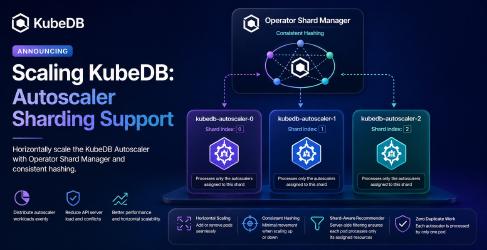
Sharding KubeDB Autoscaler (Introduced in 2026.4.27) Use Case As Kubernetes clusters grow to accommodate thousands of database instances, managing their resources efficiently becomes a critical challenge. In our previous blog, we discussed Provisioner Operator Sharding , which distributes database provisioning tasks across multiple controller instances. Today, we are excited to introduce Autoscaler Sharding using the Operator Shard Manager. Designed using the Consistent Hashing with bounded loads algorithm, this feature allows you to horizontally scale the KubeDB Autoscaler operator to efficiently distribute the continuous reconciliation and recommendation workloads among multiple controller pods.
No data found
New to KubeDB? Please start here . Chaos Testing KubeDB Managed SQL Server Availability Group Clusters with Chaos-Mesh Setup Cluster To follow along with this tutorial, you will need: A running Kubernetes cluster. KubeDB installed in your cluster. kubectl command-line tool configured to communicate with your cluster. Chaos-Mesh installed in your cluster. helm upgrade -i chaos-mesh chaos-mesh/chaos-mesh \ -n chaos-mesh \ --create-namespace \ --set dashboard.create=true \ --set dashboard.securityMode=false \ --set chaosDaemon.
READ MORESharding KubeDB Autoscaler (Introduced in 2026.4.27) Use Case As Kubernetes clusters grow to accommodate thousands of database instances, managing their resources efficiently becomes a critical challenge. In our previous blog, we discussed Provisioner Operator Sharding , which distributes database provisioning tasks across multiple controller instances. Today, we are excited to introduce Autoscaler Sharding using the Operator Shard Manager. Designed using the Consistent Hashing with bounded loads algorithm, this feature allows you to horizontally scale the KubeDB Autoscaler operator to efficiently distribute the continuous reconciliation and recommendation workloads among multiple controller pods.
READ MOREWhy do Enterprises Choose Kubernetes for Stateful Apps? In today’s rapidly evolving tech landscape, managing stateful applications—databases, caches, queues—at scale, efficiently is a top priority for enterprises. At Google Cloud Next 25, titled “Data on Kubernetes: Run stateful apps and AI workloads on GKE”, highlighted the growing adoption of Kubernetes for databases, AI, and machine learning (ML) workloads, showcasing its cost-efficiency, scalability, and performance benefits. Drawing from insights shared in that session, this blog explores why Kubernetes—paired with solutions like KubeDB from AppsCode—is the ideal platform for running stateful applications and future-proofing AI workloads.
READ MOREDeploy, manage, upgrade Kubernetes on any cloud and automate deployment, scaling, and management of containerized applications.